


- Home > Service Areas > Parker, CO > Garage Door Sensors Failure in Parker, CO






Key Takeaways
- Dust is the leading cause of sensor failure in Parker, coating lenses within weeks
- UV radiation at 5,869 feet cracks sensor housings 2 to 3 times faster than at sea level
- Direct afternoon sunlight overwhelms the infrared beam and causes false readings
- Vibration from daily door operation shifts sensor brackets out of alignment over months
- Most sensor issues cost $75 to $150 to diagnose and repair professionally
Garage door sensors in Parker fail because of dust accumulation on lenses, UV degradation of plastic housings, heat-related wiring issues, vibration-induced misalignment, and sunlight interference with the infrared beam. Parker’s dry, high-altitude climate accelerates every one of these failure modes compared to lower-altitude or more humid regions.
Photo-eye sensors are the garage door’s last line of defense against closing on a person, pet, or object. When they fail, the door either refuses to close (a nuisance) or closes without detecting an obstruction (a hazard). Both failure modes are common in Parker because the local climate attacks sensors from multiple angles. Select Garage Doors diagnoses and repairs sensor failures across the Parker area. Call the 24/7 line to schedule service.
What Causes Garage Door Sensors to Malfunction in Parker?
The five most common causes are dust-coated lenses, UV-cracked housings, sunlight interference with the beam, vibration-shifted brackets, and heat-damaged wiring. Each cause produces different symptoms and requires a different fix.
Cause-by-cause breakdown:
- Dust on lenses: Reduces beam strength. Door reverses randomly or refuses to close
- UV-cracked housings: Exposes wiring and circuit boards to moisture and debris
- Sunlight interference: Afternoon sun overwhelms the infrared beam, causing false reversals
- Vibration misalignment: Daily operation shifts brackets by fractions of a degree over months
- Heat-damaged wiring: Insulation cracks from thermal cycling, causing intermittent connections
Sensors work by sending an infrared beam from one side of the door opening to a receiver on the other side. Any disruption to that beam during closing triggers a reversal. For a deeper explanation of how sensors function, read about testing garage door auto-reverse sensors.
How Does Parker’s Climate Damage Garage Door Sensors Faster?
The UV effect on sensors is cumulative. Sensor housings are typically made from ABS plastic, which yellows, becomes brittle, and cracks under prolonged UV exposure. At sea level, sensor housings last 8 to 10 years before showing UV damage. In Parker, visible cracking often appears within 4 to 5 years on south-facing garage openings.
Dust is a daily challenge. Parker, CO‘s dry conditions and wind patterns deposit a fine layer of dust on sensor lenses between cleanings. A clean lens on Monday may have enough accumulation by Friday to reduce beam strength below the detection threshold. This is why monthly cleaning is the minimum recommendation, and biweekly cleaning is better during dry summer months.
How Can Parker Homeowners Fix Common Sensor Problems?
Clean the lenses with a soft cloth, check alignment by verifying both LED indicators are steady, tighten mounting brackets, and shade the sensors from direct sunlight. These four steps resolve 70 to 80 percent of sensor issues without professional help.
DIY sensor troubleshooting:
- Clean both sensor lenses with a soft, dry microfiber cloth
- Check LED indicators: both should show steady lights (green and amber on most models)
- If an LED flickers, gently adjust the sensor on its bracket until the light steadies
- Tighten the wing nut or bolt holding the sensor bracket to the track
- If afternoon sun causes false reversals, install a small cardboard or plastic shade over the receiving sensor
If these steps do not resolve the issue, the problem is likely wiring, a failed circuit board, or a sensor unit that needs full replacement. Wiring diagnosis requires testing voltage at the sensor terminals and tracing the wire path from sensor to opener.
For wiring and internal sensor issues, schedule a service today. Attempting to splice or reroute wiring without experience can create fire hazards or void the opener warranty.
When Should Parker Homeowners Replace Sensors Instead of Repairing?
Replace sensors when the housing is cracked or brittle from UV damage, when the LED no longer responds to alignment adjustment, when the wiring insulation is visibly deteriorated, or when the sensors are more than 8 years old and experiencing repeated failures.
Repair vs. replace decision guide:
- Dirty lenses: Clean (free)
- Misaligned brackets: Adjust (free)
- Loose wiring connection: Tighten ($0 to $75)
- Cracked housing: Replace sensor ($40 to $75 per sensor)
- Failed circuit board: Replace sensor ($40 to $75 per sensor)
- Deteriorated wiring: Replace wiring run ($75 to $150)
Replacement sensors are universal for most major opener brands. A matched pair costs $30 to $60 for the parts. Professional installation including wiring verification adds $50 to $100. The total replacement cost of $80 to $160 is a small investment for a safety system that prevents crush injuries.
| Symptom | Likely Cause | DIY Fix? | Pro Needed? | Cost |
|---|---|---|---|---|
| Door reverses randomly | Dirty lenses or sunlight | Yes (clean/shade) | If cleaning fails | $0-75 |
| Door refuses to close | Misaligned sensors | Yes (adjust bracket) | If alignment fails | $0-75 |
| LED flickering | Loose wiring or misalignment | Maybe | If tightening fails | $75-150 |
| LED off completely | Failed sensor or broken wire | No | Yes | $80-160 |
| Cracked sensor housing | UV degradation | No | Yes (replace) | $80-160 |
Frequently Asked Questions
How Often Should I Clean Garage Door Sensors in Parker?
Monthly at minimum. During dry summer months when dust is heaviest, biweekly cleaning prevents the lens coating that causes most sensor failures in Parker.
Can Sunlight Really Cause Garage Door Sensor Problems?
Yes. Direct sunlight, particularly the intense afternoon sun in Parker, overwhelms the infrared beam that sensors use. A small shade or tube mounted over the receiving sensor blocks sunlight without affecting the beam path.
How Much Does Garage Door Sensor Replacement Cost in Parker?
A matched pair of replacement sensors costs $30 to $60 for parts. Professional installation including wiring verification costs $80 to $160 total.
Do All Garage Door Openers Use the Same Sensors?
Most residential openers use compatible photo-eye sensors, but the wiring connectors may differ. Universal replacement sensors with adaptable wiring are available for all major brands.
Can I Bypass Garage Door Sensors If They Keep Failing?
Bypassing sensors removes a federally mandated safety feature and creates serious injury liability. If sensors fail repeatedly, the root cause (wiring, alignment, or environmental factor) should be diagnosed and fixed rather than bypassed.
Why Does My Garage Door Work Fine in the Morning but Fail in the Afternoon?
Afternoon sunlight interfering with the sensor beam is the most common cause. The sun angle changes throughout the day, and during certain hours, direct light hits the sensor and overwhelms the infrared signal.
How Do I Know Which Sensor Is the Sending and Which Is Receiving?
The sending sensor typically has an amber or yellow LED. The receiving sensor has a green LED. The green LED is the one that flickers or goes out when alignment is off or the beam is blocked.
Can Spiders or Insects Cause Sensor Failures in Parker?
Yes. Spiders build webs across sensor lenses, and insects nest inside cracked sensor housings. Regular cleaning and housing inspection prevents insect-related failures.
- Foundation Settling Affect Garage Doors
- Garage Door Cable Replacement in Parker
- Garage Door Rollers Replace Parker
- Garage Door Safety Testing Parker
- Garage Door Sensors Failure in Parker, CO
- Garage Door Track Alignment Parker, CO
- Hardware and Customization of Doors Parker, CO
- High-Speed Door Repair Parker, CO
- R-Value and Energy Savings Garage Doors Parker
- Sectional and Rolling Steel Doors Parker, CO
- Steel Door Durability Parker, CO


Our Colorado Service Area Coverage
Select Garage Doors provides expert residential and commercial garage door repair and installation services across the Denver metro area and surrounding Colorado communities. We serve homeowners and businesses with garage door repairs, new garage door installation, garage door opener replacement, and other professional garage door services. Check the interactive map below to view our current Colorado service areas. Don’t see your city listed? Reach out to our team, and we’ll let you know if service is available in your area.
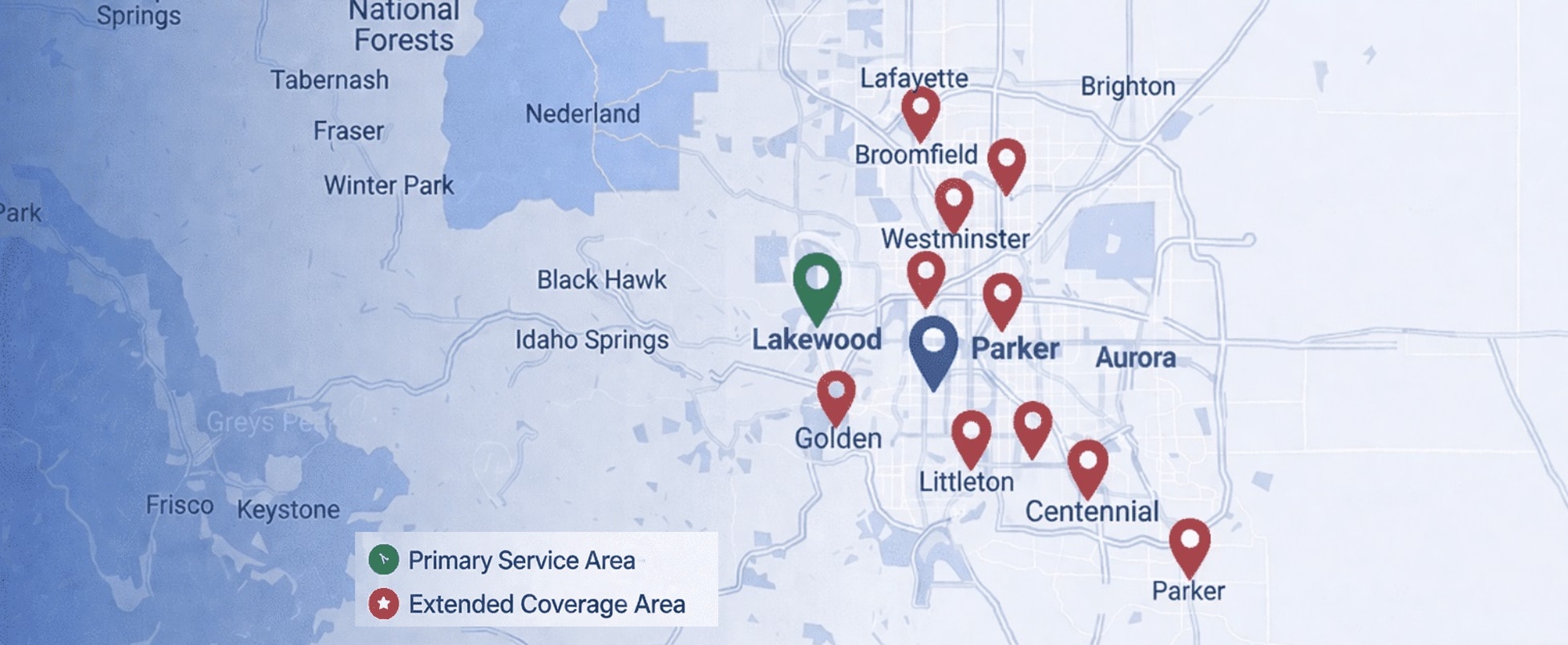
Find Garage Door Services in Your City
Every community we serve receives the same standard of service: licensed technicians, transparent estimates, manufacturer-backed warranties, and the availability that Colorado homeowners and property managers depend on.
Select your city below to view the specific residential and commercial garage door services available in your area, read local customer reviews, and schedule an appointment online.
-
Aurora
-
Brighton
-
Broomfield
-
Castle Rock
-
Centennial
-
Denver
-
Golden
-
Greenwood Village
-
Highlands Ranch
-
Lakewood
-
Littleton
-
Morrison
-
Parker, CO
-
Thornton
-
Westminster
-
Wheat Ridge
Ready to Fix or Upgrade Your Garage Door?
Book Now and Get $25 off your First Service.
This Month's Specials

Valid Until July 31, 2026
Must be mentioned during call booking. Limit one per customer. Cannot be combined with other offers. Restrictions apply. Call for details.