

Common Issues Leading to Emergency Commercial Garage Door Repair in Parker, CO

Key Takeaways
- Broken springs are the most frequent driver of emergency commercial garage door calls in Parker, CO. Commercial torsion springs under high-cycle loads in Colorado’s freeze-thaw climate fail faster than manufacturer cycle ratings assume.
- Damaged or misaligned tracks are typically caused by impact from vehicles or equipment and are an emergency because they prevent safe door operation and leave the facility exposed until corrected.
- Sensor failures on commercial doors in Parker, CO frequently trace to debris accumulation, photo-eye misalignment from equipment vibration, or sun-angle interference — not to the sensor unit itself failing.
- Worn rollers are the most commonly deferred maintenance item on commercial garage doors and the most predictable source of emergency calls when they fail mid-cycle and allow the door to jump the track.
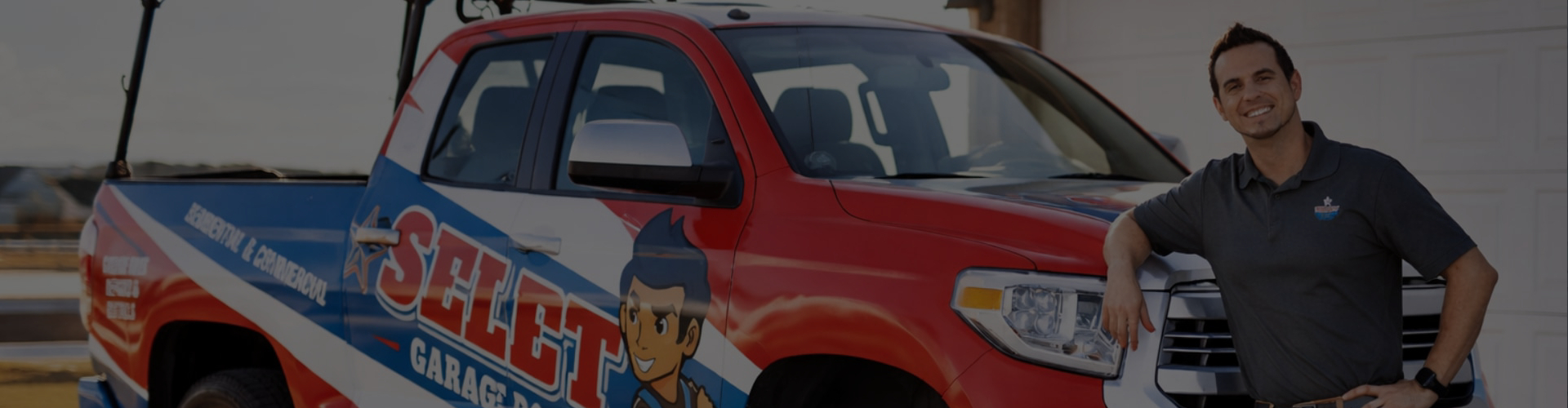
- Select Garage Doors handles emergency commercial garage door repairs throughout Parker, CO and the Denver metro, with technicians who specialize in commercial systems, not residential carryover work.
Table of Contents
Commercial garage doors in Parker, CO take far more abuse than residential ones. Delivery vehicles, forklifts, and fleet traffic cycle through the same opening dozens of times each day, and Colorado’s freeze-thaw climate and high-altitude UV exposure compound the wear on every moving part. Select Garage Doors responds to commercial garage door emergencies throughout Parker and the Denver metro, and the same five issues come up in the majority of those calls.
Understanding what drives commercial emergency repair calls helps Parker facility managers and business owners maintain their doors proactively, catch developing problems before they become operational disruptions, and respond correctly when something does fail unexpectedly.
1. Broken Springs
Broken torsion springs are the most common driver of emergency commercial garage door calls in Parker, CO. Commercial springs carry the full weight of a heavy-gauge sectional door on every one of the hundreds of cycles it performs each week. Standard commercial torsion springs are rated at 100,000 cycles, but Parker’s freeze-thaw cycling and the high-altitude UV exposure that accelerates metal oxidation on unprotected coils can bring a spring to failure before that cycle rating is reached, particularly on doors that run 20 or more cycles per day.
The failure is usually abrupt. A commercial torsion spring breaks with a loud crack and leaves the door either inoperable or extremely difficult to move manually. For a loading dock, auto service bay, or distribution facility, an inoperable door is a business disruption that compounds quickly: vehicles can’t load or unload, climate control leaks into an open bay, and security of the facility is compromised until the door can be closed and locked.
Proactive spring inspection is the most direct way to avoid this emergency. A technician can assess remaining service life based on visible coil wear, corrosion, and the gap between actual cycle count and rated life. Replacing springs before they fail — rather than after — costs the same in parts and less in total because it avoids the emergency response fee and the operational disruption.
2. Damaged or Misaligned Tracks
Commercial garage door tracks in Parker, CO take impact damage from forklifts, delivery vehicles, and pallets regularly, and even a minor impact that bends or shifts a track section can make the door inoperable or unsafe to operate. A track that has been bent inward blocks roller travel and causes the door to jam mid-cycle. A track that has shifted out of its mounting brackets runs the door at an angle that strains the spring, cables, and opener motor on every subsequent cycle, accelerating wear across the entire system.
Misalignment that stops short of a full jam is the trickier situation because the door continues to operate while the damage accumulates. Unusual resistance during opening or closing, grinding sounds that were not present before, or a door that visibly tracks at a slight angle are all signs that a track has shifted. Catching misalignment early limits the repair to straightening or repositioning the affected track section. Letting it continue typically results in worn rollers, cable wear, and eventually a door that goes off-track during operation and requires a more expensive repair.
Track bracket anchoring is a common maintenance gap in commercial facilities. Brackets that are not torqued to the correct specification loosen over time from the vibration of daily commercial door operation. A biannual torque check of all track mounting hardware is a simple preventive step that keeps the track in the correct position and reduces the risk of a bracket-induced misalignment event.
3. Malfunctioning Safety Sensors
Safety sensor failures on commercial garage doors in Parker, CO are more common than most facility managers expect, and they rarely involve a genuinely defective sensor unit. The most frequent causes are debris accumulation on the sensor lens face, vibration-induced misalignment of the sensor mounting bracket from ongoing equipment traffic, and afternoon sun-angle interference on west-facing commercial openings. All three produce the same symptom: the door refuses to close or reverses on every close attempt, which looks like an opener failure but traces directly to the sensor system.
Commercial environments generate more debris than residential ones. Forklift dust, cardboard fibers, dirt tracked in from outside, and condensation that dries on the sensor lenses are all common in Parker-area warehouses and service facilities. A monthly lens cleaning with a dry cloth is the simplest sensor maintenance step and prevents most debris-related sensor faults before they cause a failed close. Sensor alignment checks should be part of a quarterly maintenance inspection, since commercial door vibration from heavy equipment cycling shifts sensor brackets over time in ways that residential use does not.
For a closer look at what separates a thorough commercial repair service from one that treats commercial doors the same as residential ones, our post on key features to look for in a commercial garage door repair service in Parker, CO covers those distinctions in detail.
4. Worn-Out Rollers
Worn rollers are the most predictable source of commercial garage door emergency calls in Parker, CO because the failure pattern is gradual and visible long before a roller actually fails. A roller that has developed flat spots creates grinding and scraping sounds as it moves through the track. One that has worn enough to lose proper contact with the track causes the door to run unevenly and places lateral load on the track mounting hardware. When a roller fails completely during a cycle, the door can jump the track, turning a component replacement into an off-track emergency with a door stuck open or closed mid-cycle.
Commercial steel rollers have longer rated service lives than residential nylon rollers but create more noise against the track as they age. In Parker’s dry semi-arid climate, roller lubrication evaporates faster than manufacturer maintenance schedules assume, which accelerates wear on unlubricated rollers running steel-on-steel. A biannual lubrication schedule with a commercial-grade lubricant rated for Colorado’s low-humidity conditions extends roller service life beyond what the standard manufacturer interval delivers.
Replacing rollers proactively on a documented schedule — rather than waiting for failure — costs less than an emergency repair call and eliminates the operational disruption of a door stuck mid-cycle. For high-cycle commercial doors in Parker, CO running 20 or more cycles daily, a roller replacement interval shorter than the standard seven-to-ten-year residential recommendation is appropriate.
5. Faulty Opener Mechanism
Commercial garage door opener failures in Parker, CO most often trace to one of three components: the control board, the motor itself, or the drive mechanism. Control board failures produce erratic behavior — doors that activate without input, refuse to respond to commands, or complete partial cycles and then stop. Motor failures typically present as a unit that hums without moving the door, indicating power is reaching the motor but it cannot drive the load. Drive mechanism wear, most common on chain drive commercial openers running at high cycle counts, produces grinding during operation before it produces a full failure.
Commercial openers operate under heavier loads and higher cycle counts than residential units, and the service life expectations need to reflect that. A commercial opener that has reached the end of its cycle rating on a high-traffic Parker facility is one that deserves a replacement before it fails mid-cycle and leaves a loading dock or service bay without a working door. Scheduled opener replacement, tied to the cycle count and operational history of the specific unit, is less expensive than an emergency replacement under time pressure.
Electrical issues at the power supply level also drive commercial opener failures in Parker, CO. Commercial facilities often have more demanding electrical environments than residential garages, with voltage fluctuations from heavy equipment cycling, shared circuits, and older wiring that was not originally designed for current commercial load requirements. An opener that fails repeatedly without obvious mechanical cause should be assessed by a technician who checks both the unit itself and the quality and stability of the power supply it is running on.
Preventing Emergency Commercial Repairs in Parker, CO
The five issues above drive the majority of emergency commercial calls in Parker, and all five are predictable with proper maintenance. A documented biannual maintenance program covering spring inspection, track torque check, sensor alignment and cleaning, roller lubrication and replacement planning, and opener performance assessment eliminates most of the surprise failures that disrupt operations and cost more to fix under emergency conditions than they would under a scheduled service visit.
Select Garage Doors is a veteran-owned, BBB A+ rated company serving Parker, CO commercial clients with technicians who specialize in commercial door systems. We offer maintenance contracts alongside repair services so facility managers can stay ahead of the issues that drive emergency calls. Request a commercial service quote or call 720-339-2442.
Parker businesses and commercial facilities in Castle Rock, Greenwood Village, Lakewood, and across the Denver metro count on Select Garage Doors for commercial door maintenance and emergency repair.
Frequently Asked Questions
What causes most emergency commercial garage door repairs in Parker, CO?
Broken torsion springs and off-track doors from worn or failed rollers account for the largest share of emergency commercial calls in Parker, CO. Both failures produce a door that is either inoperable or unsafe to operate until the repair is made. Parker’s freeze-thaw cycling accelerates spring metal fatigue faster than the manufacturer’s rated service life assumes in milder climates, which is why commercial spring failures cluster in late fall and early winter when overnight temperatures drop sharply after warm afternoons.
How often should commercial garage door springs be inspected in Parker, CO?
Commercial torsion springs on Parker, CO facilities running 15 or more daily cycles should be professionally inspected at least twice per year. An inspector checks for visible coil wear, corrosion, audible creaking under load, and the relationship between the door’s estimated cycle count and the spring’s rated service life. Springs approaching 80 percent of their rated cycle life are candidates for proactive replacement before failure, particularly in Colorado’s climate where thermal stress accelerates fatigue beyond what standard cycle ratings predict.
Can a commercial garage door sensor be repaired without replacing the unit?
Yes, and this is the most common outcome for commercial sensor problems in Parker, CO. Sensor malfunctions that trace to debris on the lens, vibration-induced misalignment, or sun-angle interference are resolved through cleaning, realignment, and minor repositioning of the mounting bracket. An actual sensor unit failure requiring replacement is less common than these environmental causes, but it does happen, particularly on sensors that have been physically impacted by equipment or exposed to prolonged moisture. A technician can diagnose which cause applies in a single inspection visit.
How long do commercial garage door rollers last in Parker, CO?
Commercial steel rollers on doors running 15 or more daily cycles in Parker, CO typically last five to eight years with proper lubrication. Parker’s dry, semi-arid climate evaporates lubricants faster than manufacturer maintenance schedules assume, which shortens roller service life on systems that follow a standard annual lubrication interval without accounting for Colorado’s conditions. A biannual lubrication schedule with a commercial-grade product rated for low-humidity environments extends roller service life and reduces the grinding wear on tracks that accelerates from running dry.
What should I do if my commercial garage door goes off-track in Parker, CO?
Stop all door operation immediately and do not attempt to run the opener. An off-track commercial door is under spring tension and cable load, and forcing it to move manually or with the opener can cause the door to drop suddenly, damage the opener drive rail, or cause a cable to snap under redirected load. Secure the door in whatever position it stopped and call for emergency service. In the meantime, treat the opening as unsecured and take whatever steps your facility’s security protocol requires for an open or compromised entry point.

Looking for a deal?
Call us or to learn about our current promotions and seasonal offers.


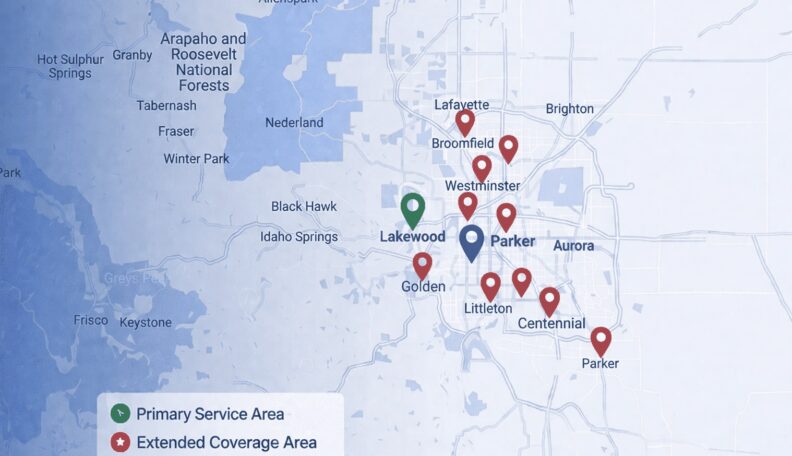
Service Area: 50+ Cities Across Metro Denver
Select Your Nearest Location
Hours: Mon-Fri 8am-5pm
Sunday Emergency Only
Avg Response Time: 18 minutes
Hours: Mon-Fri 8am-5pm
Sunday Emergency Only
Avg Response Time: 18 minutes
Hours: Mon-Fri 8am-5pm
Sunday Emergency Only
Avg Response Time: 18 minutes
Hours: Mon-Fri 8am-5pm
Sunday Emergency Only
Avg Response Time: 18 minutes
Hours: Mon-Fri 8am-5pm
Sunday Emergency Only
Avg Response Time: 18 minutes
Hours: Mon-Fri 8am-5pm
Sunday Emergency Only
Avg Response Time: 18 minutes
Hours: Mon-Fri 8am-5pm
Sunday Emergency Only
Avg Response Time: 18 minutes
Hours: Mon-Fri 8am-5pm
Sunday Emergency Only
Avg Response Time: 18 minutes
Hours: Mon-Fri 8am-5pm
Sunday Emergency Only
Avg Response Time: 18 minutes
Hours: Mon-Fri 8am-5pm
Sunday Emergency Only
Avg Response Time: 18 minutes
Hours: Mon-Fri 8am-5pm
Sunday Emergency Only
Avg Response Time: 18 minutes
Hours: Mon-Fri 8am-5pm
Sunday Emergency Only
Avg Response Time: 18 minutes
Hours: Mon-Fri 8am-5pm
Sunday Emergency Only
Avg Response Time: 18 minutes
Hours: Mon-Fri 8am-5pm
Sunday Emergency Only
Avg Response Time: 18 minutes
Hours: Mon-Fri 8am-5pm
Sunday Emergency Only
Avg Response Time: 18 minutes
We Service: Parker, Castle Rock, Greenwood Village, Lakewood, Littleton, Centennial, Highlands Ranch 40+ More Cities