

Commercial Garage Door Safety Tips for Parker Businesses
Key Takeaways
- OSHA 29 CFR 1910.147 (lockout/tagout) directly governs commercial garage door repairs in Colorado — power must be disconnected and secured before any work begins.
- Springs and cables on commercial doors carry extreme tension and must only be inspected and adjusted by a certified technician, never on-site staff.
- Colorado winters create a specific hazard: ice at the bottom seal causes sudden uncontrolled closes. Inspect seals before every freeze cycle.
- A door that fails the auto-reverse test or will not hold position at 4 ft height must be locked out immediately and posted out of service.
- Delaying commercial garage door repairs in Parker creates OSHA liability, workers’ compensation exposure, and potential business interruption claims.
Maintaining a commercial garage door is essential for workplace safety and efficiency. Repairing these large, heavy doors can pose serious risks if not handled correctly. Following proper safety procedures is crucial to prevent accidents, equipment damage, or legal liabilities. Select Garage Doors puts safety first on every Parker, CO commercial job. Here are the key precautions to follow:
1. Always Disconnect Power
Before starting any repairs, disconnect the power to the garage door. This prevents accidental activation, which could lead to injury or equipment damage. Always ensure the power source is securely off before proceeding.
2. Inspect for Structural Damage
Carefully inspect the garage door for any structural damage before beginning repairs. Identifying issues like bent tracks or broken springs early can help prevent injuries during the repair process. How fire-rated commercial garage doors factor into safety compliance is worth understanding before any structural repair on a commercial property.
3. Use Proper Tools and Equipment
Using the right tools is essential for safe and effective repairs. Make sure all your equipment is in good condition and appropriate for the task. Misusing tools can lead to injury or further damage to the door.
4. Wear Protective Gear
Always wear protective gear such as gloves, safety glasses, and steel-toed boots when working on a commercial garage door. These large, heavy systems can cause serious injury if a component shifts unexpectedly.
5. Follow the Manufacturer Guidelines
Adhering to the manufacturer repair and safety guidelines can prevent mistakes. These guidelines are specifically designed to minimize risk and ensure proper function after the repair. Ongoing maintenance routines for garage doors pair well with manufacturer specs and help catch issues before they become safety hazards.
Staying safe during commercial garage door repairs requires attention to detail and established protocols. Being cautious lets you complete repairs smoothly and avoid setbacks. If the damage is beyond repair, a new commercial garage door installation in Parker may be the most cost-effective path forward. To get expert help from a team that treats every job safely, schedule commercial door repair in Parker today and we will get you on the schedule.
For commercial garage door repairs in Parker done right the first time, call (720) 339-2442. We serve Parker, Castle Rock, Greenwood Village, Lakewood, and the greater Denver metro area.
OSHA Standards That Apply to Commercial Garage Door Repairs in Colorado
Commercial garage doors are regulated workplace equipment, and OSHA treats them as such. The most directly applicable standard is 29 CFR 1910.147, the Control of Hazardous Energy standard, commonly called lockout/tagout (LOTO). This regulation requires that any energy source capable of causing unexpected startup or movement must be isolated and locked out before maintenance begins. For a commercial garage door, that means disconnecting the opener circuit at the breaker, applying a lockout device, and tagging it with a dated warning before anyone touches springs, cables, tracks, or the operator unit.
OSHA’s General Duty Clause (Section 5(a)(1)) also applies to heavy door systems. Employers must provide a workplace free from recognized hazards, and a 400-lb commercial door with a failing torsion spring or fraying cable is a recognized hazard.
Colorado operates under federal OSHA jurisdiction through the Colorado Department of Labor (COSH), meaning all federal standards apply without modification. The Door and Access Systems Manufacturers Association (DASMA) publishes technical data sheets and installation guidelines that courts and OSHA inspectors treat as industry safety benchmarks. Following DASMA guidelines does not create automatic OSHA compliance, but deviating from them without documented justification strengthens a liability claim against your business in the event of an injury.
Parker businesses that need an inspection, repair, or compliance check from a team that knows these standards can find Select Garage Doors serving Douglas County and the Denver metro with technicians who work to OSHA protocols on every commercial call.
Commercial Garage Door Safety Inspection Checklist
| Component | Inspection Frequency | Warning Signs | Who Should Inspect |
|---|---|---|---|
| Springs (torsion/extension) | Monthly | Gaps, rust, uneven tension | Certified technician only |
| Cables | Monthly | Fraying, kinking, corrosion | Certified technician only |
| Tracks | Weekly | Bent sections, debris, misalignment | On-site staff |
| Photo-eye sensors | Weekly | Misalignment, dirty lens | On-site staff |
| Auto-reverse (safety reversal) | Monthly | Fails to reverse on 2-inch obstruction | On-site staff |
| Panel structure | After any impact | Dents, warping, cracks | On-site staff |
| Motor and operator | Quarterly | Unusual noise, slow cycle | Certified technician only |
Seasonal Safety Priorities for Colorado Commercial Doors
- Winter: Ice buildup at the bottom seal is one of the most common causes of dangerous sudden-close events at altitude. Parker temperatures regularly drop below 10°F in January; when a frozen seal breaks free, the door can slam shut without warning. Inspect and replace worn bottom seals before the first hard freeze, and apply silicone lubricant to all moving metal parts before temperatures consistently fall below 20°F. Standard petroleum-based lubricants thicken and fail in sub-zero conditions.
- Spring: After every significant hail event (the Front Range averages 9 to 10 hail days per year), check panels for dents and verify photo-eye sensor alignment. Even minor hail impact can knock sensors off axis, causing the door to behave unpredictably. April through June is the highest-risk period for storm-related sensor failures in Douglas County.
- Summer: Parker’s high UV intensity at 5,869 ft elevation degrades plastic sensor housings faster than manufacturers’ ratings, which are typically tested at sea-level UV levels. Discolored, cracked, or brittle sensor housings signal it is time to replace the photo-eye assembly, not just wipe the lens.
- Fall: Seal replacement season. Check all perimeter seals before the heating season begins, both to prevent cold air infiltration into conditioned warehouse space and to eliminate the ice-bonding risk that creates winter slam events.
- Year-round: Colorado’s 40 to 60°F daily temperature swings cause metal tracks, springs, and fasteners to expand and contract repeatedly. Spring tension that was correct in October may be measurably different in February. Schedule a calibration check at each seasonal transition.
When to Take a Commercial Door Out of Service for Repairs
Some commercial garage door conditions require immediate lockout, not a scheduled service call. A torsion spring that produces a loud bang followed by the door dropping is a broken spring, not a mechanical quirk — the door must come out of service the moment that sound occurs. A cable that is visibly frayed or kinked anywhere along its length carries the same directive. Both components are under extreme stored energy; continued operation risks complete failure, injury, and structural damage to any vehicle or person in the opening.
Two functional tests also justify immediate lockout: if the door will not hold position when stopped manually at 4 feet off the ground, the spring tension or cable drum is failing; and if the auto-reverse test fails (place a 2-inch obstruction under the center of the door and trigger a close cycle — a compliant door reverses on contact), the UL 325 safety standard is not being met and the door poses a crush hazard.
When either condition is confirmed, notify all employees that the opening is locked out, post a clearly visible out-of-service sign on both sides of the door, and do not bypass, disconnect, or tamper with the operator to allow continued use. OSHA inspectors view improvised bypasses as willful violations carrying elevated fine schedules. Contact a certified technician promptly — call (720) 339-2442 to get a technician dispatched to your Parker location the same day.
Frequently Asked Questions
What OSHA regulations apply to commercial garage door repairs in Colorado?
The most directly applicable standard is OSHA 29 CFR 1910.147, the Control of Hazardous Energy (lockout/tagout) regulation, which requires isolating all energy sources before repair work begins on a commercial garage door. OSHA’s General Duty Clause (Section 5(a)(1)) also requires employers to address recognized hazards like deteriorating springs or cables. Colorado operates under federal OSHA jurisdiction, so all federal standards apply without state-level modification.
How often should a commercial garage door be professionally inspected?
DASMA recommends a professional inspection at minimum once per year for commercial doors under regular use. High-cycle environments, such as loading docks or fleet garages operating 50 or more cycles per day, benefit from semi-annual inspections. Springs and cables on commercial doors have a finite cycle life — typically 25,000 to 100,000 cycles depending on gauge — and professional inspection tracks wear before failure occurs.
Can employees safely do minor commercial garage door maintenance themselves?
Employees can safely perform visual inspections, wipe down photo-eye sensor lenses, clear track debris, and run the auto-reverse test. Any task involving springs, cables, drums, or spring tension adjustment must be performed by a certified technician. These components store significant mechanical energy — a commercial torsion spring can release enough force to cause fatal injury if handled without proper tools and training.
What is lockout/tagout and why does it matter for commercial door repairs?
Lockout/tagout (LOTO) is an OSHA-required procedure under 29 CFR 1910.147 that isolates all energy sources before maintenance begins. For a commercial garage door, this means disconnecting the opener at the circuit breaker, applying a physical lock so the breaker cannot be re-energized, and attaching a tag identifying who performed the lockout. It prevents a coworker from unknowingly restoring power while someone is working on the door mechanism. Failure to follow LOTO procedures is one of OSHA’s most frequently cited serious violations.
How do Colorado winters affect commercial garage door safety?
Freezing temperatures at Parker’s 5,869 ft elevation create two specific hazards. First, ice can bond the bottom seal to the floor overnight; when the operator activates in the morning, the sudden break can cause an uncontrolled slam or structural damage to the panel. Second, cold thickens lubricants and increases spring brittleness, meaning springs that were within spec in fall may be near failure by February. Pre-winter maintenance, including seal inspection and cold-rated lubrication, addresses both risks before the damage occurs.
What are the liability risks of delaying commercial garage door repairs in Colorado?
Colorado courts have found property owners liable for negligence when documented awareness of a hazard precedes an injury. The cost of a same-day service call is a fraction of any of these outcomes.
Looking for a deal?
Call us or to learn about our current promotions and seasonal offers.


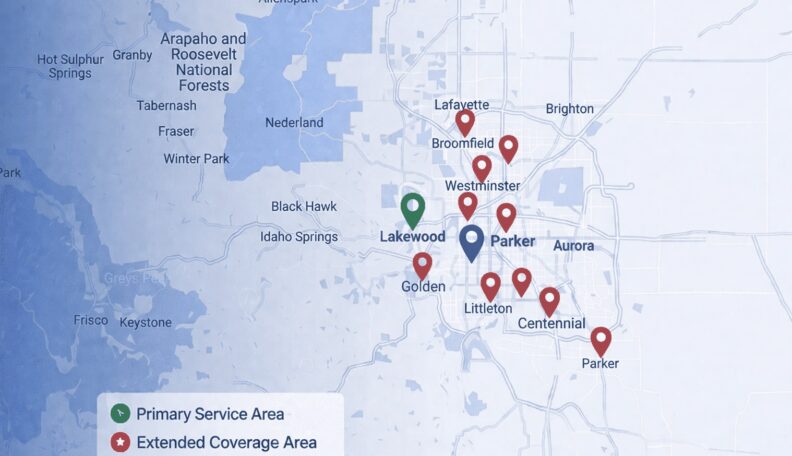
Service Area: 50+ Cities Across Metro Denver
Select Your Nearest Location
Hours: Mon-Fri 8am-5pm
Sunday Emergency Only
Avg Response Time: 18 minutes
Hours: Mon-Fri 8am-5pm
Sunday Emergency Only
Avg Response Time: 18 minutes
Hours: Mon-Fri 8am-5pm
Sunday Emergency Only
Avg Response Time: 18 minutes
Hours: Mon-Fri 8am-5pm
Sunday Emergency Only
Avg Response Time: 18 minutes
Hours: Mon-Fri 8am-5pm
Sunday Emergency Only
Avg Response Time: 18 minutes
Hours: Mon-Fri 8am-5pm
Sunday Emergency Only
Avg Response Time: 18 minutes
Hours: Mon-Fri 8am-5pm
Sunday Emergency Only
Avg Response Time: 18 minutes
Hours: Mon-Fri 8am-5pm
Sunday Emergency Only
Avg Response Time: 18 minutes
Hours: Mon-Fri 8am-5pm
Sunday Emergency Only
Avg Response Time: 18 minutes
Hours: Mon-Fri 8am-5pm
Sunday Emergency Only
Avg Response Time: 18 minutes
Hours: Mon-Fri 8am-5pm
Sunday Emergency Only
Avg Response Time: 18 minutes
Hours: Mon-Fri 8am-5pm
Sunday Emergency Only
Avg Response Time: 18 minutes
Hours: Mon-Fri 8am-5pm
Sunday Emergency Only
Avg Response Time: 18 minutes
Hours: Mon-Fri 8am-5pm
Sunday Emergency Only
Avg Response Time: 18 minutes
Hours: Mon-Fri 8am-5pm
Sunday Emergency Only
Avg Response Time: 18 minutes
We Service: Parker, Castle Rock, Greenwood Village, Lakewood, Littleton, Centennial, Highlands Ranch 40+ More Cities