


Garage Door Repair Tips and Tricks for Parker, CO Homeowners
Key Takeaway: Most garage door problems fall into two buckets: quick fixes any homeowner can handle in fifteen minutes, and tension-loaded repairs that need a professional with the right tools. Knowing which is which protects your wallet and prevents the kind of injury that lands DIYers in the ER.
A garage door is the heaviest moving object in most Parker homes. It opens and closes thousands of times a year, holds back the largest opening in the structure, and ties together eight or nine moving parts that each have to work in sync. When something goes wrong, the right next step depends entirely on which part failed and how much tension is in the system.
At Select Garage Doors, we walk Parker, CO homeowners through these decisions every day. Some problems are a fifteen-minute fix with a can of lubricant. Others involve 200 pounds of stored spring tension and belong in the hands of a trained technician. This guide breaks down what to know about your garage door, what to try first, when to stop, and how to keep the whole system running for the long haul.
How a Garage Door System Actually Works
A residential garage door system has eight major components, and a problem with any one of them shows up as a symptom somewhere else. Knowing the cast of characters helps you trace a fault back to its source.
- Door panels: the steel, wood, or composite sections that stack as the door rolls up. They carry no tension on their own.
- Torsion or extension springs: the part that does the actual lifting. A typical residential torsion spring holds 200 to 400 pounds of stored force, which makes this the most dangerous component on the door.
- Tracks and rollers: the metal guides and wheels that constrain the door’s path of travel. Damage here usually shows up as binding, jumping, or grinding noises.
- Cables and drums: transfer spring tension into vertical lift through the cables wound around drums on the spring shaft.
- Hinges and brackets: join the panels together and connect them to the rollers. They wear out over years of cycling.
- Opener motor and logic board: the powered unit that handles open and close cycles, manages safety sensors, and stores travel limits in memory.
Two more elements round out the system: the photo-eye safety sensors near the floor, and the weatherstripping along the bottom and sides. Both are quick to replace, and both fail more often than the heavier components above.
Quick Fixes You Can Try Before Calling a Pro
Before scheduling a service call, work through this DIY checklist. Most garage door annoyances trace back to one of these five quick fixes.
- Lubricate the moving parts. Spray a silicone-based or lithium garage-door lubricant on all hinges, rollers, springs, and the opener rail. Avoid WD-40, which is a solvent, not a lubricant. This single step fixes most noisy doors and slow-cycle complaints.
- Tighten the hardware. Years of vibration loosen the nuts and bolts holding hinges and brackets to the door and the track to the framing. Walk the door with a socket wrench and snug everything up. Do not overtighten, since stripped threads are worse than loose ones.
- Test the safety reverse. Place a 2×4 flat on the floor under the door and close it. The door should reverse on contact. If it does not, your UL 325 auto-reverse is failing and the opener needs adjustment or replacement.
- Clean the photo-eye sensors. Wipe both lenses with a dry microfiber cloth. Dust, cobwebs, and pollen are the number one cause of doors that refuse to close fully.
- Replace the remote battery. A weak battery shows up as intermittent operation, short remote range, or random refusals to respond. Most opener remotes use a CR2032 or 9V battery available at any hardware store.
If the issue persists after all five, the problem is past quick-fix territory and a technician should diagnose it.
Common Problems and Where the DIY Line Falls
This table covers the most common problems we see in Parker homes, what to try first, and where the DIY line falls.
| Problem | First DIY Check | When to Stop and Call a Pro |
|---|---|---|
| Door is noisy or grinding | Lubricate hinges, rollers, springs | If lubrication does not quiet it, rollers or bearings are worn |
| Door reverses before closing | Clean sensor lenses, check alignment | If LEDs still blink after cleaning, sensor or wiring fault |
| Door is heavy to lift manually | Disconnect opener and lift halfway to test balance | If door does not stay halfway, springs need professional adjustment |
| Spring has a visible gap or break | Stop using the door immediately | Always; torsion springs are under extreme tension |
| Cables fraying or off the drum | Stop using the door | Always; combined spring and cable failure can cause the door to drop |
| Opener motor runs but door does not move | Check for disengaged trolley (red release cord pulled) | If trolley is engaged, carriage is broken or gear is stripped |
A Year-Round Garage Door Maintenance Schedule
Regular maintenance is the single biggest factor in how long a garage door lasts. The schedule below covers the basics for a Parker home in standard residential use.
| Time of Year | Maintenance Task | Why |
|---|---|---|
| Spring | Wipe weatherstripping and lubricate moving parts | Winter dust accumulates; fresh lubrication prevents binding |
| Spring | Test photo-eye sensor alignment | Vibration from winter use can shift alignment |
| Summer | Inspect and clean tracks of debris | Dust and pollen build up in tracks during dry months |
| Fall | Tighten all hinges, brackets, and track bolts | Pre-winter tune-up before cold makes loose hardware worse |
| Fall | Replace weatherstripping if cracked or torn | Cold air leaks through worn seals; replace before first freeze |
| Winter | Test balance and auto-reverse safety feature | Cold weather stresses springs and triggers most breakages |
| Annual | Professional tune-up with spring tension check | A licensed technician inspects what homeowners cannot safely test |
How Parker Weather Affects Repair Needs
Parker’s climate puts unique stress on every component of a garage door. The patterns below show up year after year in our service calls.
Cold snaps are the biggest factor. When temperatures drop below 20°F, steel torsion springs become more brittle and snap more often, especially in the first big freeze of the season. Lubricant on the springs also thickens in the cold, which can cause the door to feel heavier and trigger the opener’s force limit. Pre-winter lubrication and a tune-up before the first freeze prevent most cold-snap breakdowns.
High-altitude UV is the second factor. At 5,869 feet, the sun is roughly 25% more intense than at sea level. UV breaks down weatherstripping, plastic opener housings, and decorative composite trim faster than at lower elevations. Plan on replacing weatherstripping every 3 to 5 years instead of the 7 to 10 you would see in a coastal home.
Dust and pollen round out the trio. Spring construction dust from Douglas County growth and summer dry-season dust coat sensor lenses, lubrication points, and tracks faster than in a wet climate. A quarterly wipe-down keeps the system running clean.
Signs It Is Time to Upgrade Your System
Sometimes the right move is a system upgrade rather than another repair. Watch for these signals:
- Opener older than 12 to 15 years: older units lack rolling-code security and modern safety standards. Replacements are quieter, smarter, and more efficient.
- Door material starting to fail: rust spots on steel doors, rot or warp on wood doors, or repeated panel damage signal that the door has aged out. Replacement is cheaper than continuous patchwork.
- No safety auto-reverse function: doors built before UL 325’s 1993 implementation are a safety hazard. Upgrade is non-negotiable.
- Uninsulated door on an attached garage: new insulated doors can cut winter heating costs noticeably for homes with attached garages in Parker’s climate.
- No smartphone or smart-home integration: modern openers connect to MyQ, HomeKit, and Google Home for remote monitoring and control. A good upgrade for homes that already use connected devices.
Get Expert Help for Tough Repairs
Quick fixes solve a lot of garage door problems, but some repairs need a trained technician with the right tools, replacement parts, and experience to do the work safely. Spring replacements, cable repairs, opener motor swaps, and panel replacements all fall into that category.
At Select Garage Doors, our veteran-owned team covers residential garage door repair and maintenance across our Denver Metro service areas with upfront pricing and a 100% satisfaction guarantee. For professional garage door services in Parker, we are a phone call away.
Call us at (720) 339-2442 to schedule a tune-up or repair visit.
Frequently Asked Questions
How often should I lubricate my garage door?
Most residential garage doors need lubrication twice a year, typically once in spring and once in fall. Apply a silicone or lithium garage-door spray to hinges, rollers, springs, and the opener rail. Avoid WD-40, which is a solvent that strips lubrication rather than adding it.
What is the most common DIY garage door repair?
Photo-eye sensor cleaning and alignment is the most common DIY fix, followed by hardware tightening and remote battery replacement. Together, these handle the majority of homeowner-reported problems that look serious but are simple to resolve.
Can I replace my garage door spring myself?
We strongly recommend against it. Residential torsion springs hold 200 to 400 pounds of stored tension and have caused fatal injuries when handled without specialized winding bars and proper technique. The cost of professional replacement is small compared to the risk.
How long does a residential garage door last?
With regular maintenance, a residential garage door typically lasts 20 to 30 years. Springs usually need replacement at the 10 to 15 year mark, and openers usually need replacement at 12 to 15 years. The door itself often outlasts both.
Why is my garage door so loud all of a sudden?
Sudden noise usually means dry rollers and hinges, loose hardware, or worn opener gears. A lubrication and hardware tightening pass handles the first two cheaply. Persistent grinding after lubrication usually points to opener internals.
How much does it cost to maintain a garage door?
Homeowners who do their own quarterly cleaning and lubrication can stretch the professional tune-up to every other year.
What does it mean if my garage door is balanced incorrectly?
A correctly balanced door should stay in place when lifted halfway with the opener disconnected. If it falls or rises on its own, the springs are out of balance, which means the opener is doing extra work and the spring system is stressing toward early failure. Balance correction requires spring adjustment, which is a professional job.
When is a garage door problem an emergency?
Broken springs, broken cables, a door stuck in the open position, and any situation where the door has dropped or is unsafe to operate count as emergencies. Stop using the door, disconnect the opener if necessary, and call for emergency service rather than forcing operation.
Looking for a deal?
Call us or to learn about our current promotions and seasonal offers.



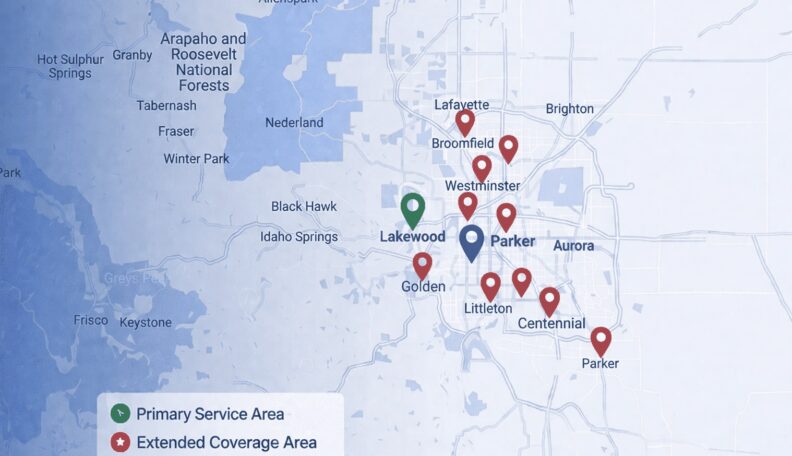
Service Area: 50+ Cities Across Metro Denver
Select Your Nearest Location
Hours: Mon-Fri 8am-5pm
Sunday Emergency Only
Avg Response Time: 18 minutes
Hours: Mon-Fri 8am-5pm
Sunday Emergency Only
Avg Response Time: 18 minutes
Hours: Mon-Fri 8am-5pm
Sunday Emergency Only
Avg Response Time: 18 minutes
Hours: Mon-Fri 8am-5pm
Sunday Emergency Only
Avg Response Time: 18 minutes
Hours: Mon-Fri 8am-5pm
Sunday Emergency Only
Avg Response Time: 18 minutes
Hours: Mon-Fri 8am-5pm
Sunday Emergency Only
Avg Response Time: 18 minutes
Hours: Mon-Fri 8am-5pm
Sunday Emergency Only
Avg Response Time: 18 minutes
Hours: Mon-Fri 8am-5pm
Sunday Emergency Only
Avg Response Time: 18 minutes
Hours: Mon-Fri 8am-5pm
Sunday Emergency Only
Avg Response Time: 18 minutes
Hours: Mon-Fri 8am-5pm
Sunday Emergency Only
Avg Response Time: 18 minutes
Hours: Mon-Fri 8am-5pm
Sunday Emergency Only
Avg Response Time: 18 minutes
Hours: Mon-Fri 8am-5pm
Sunday Emergency Only
Avg Response Time: 18 minutes
Hours: Mon-Fri 8am-5pm
Sunday Emergency Only
Avg Response Time: 18 minutes
Hours: Mon-Fri 8am-5pm
Sunday Emergency Only
Avg Response Time: 18 minutes
Hours: Mon-Fri 8am-5pm
Sunday Emergency Only
Avg Response Time: 18 minutes
We Service: Parker, Castle Rock, Greenwood Village, Lakewood, Littleton, Centennial, Highlands Ranch 40+ More Cities